This topic is close to us not only in theory. At EUCONLAW Group’s Warsaw office, students regularly complete internships, including international students, gaining hands-on experience in a real professional environment. The most dedicated participants are later offered the opportunity to join our team.
For this reason, the legal employment of students is not an abstract issue for us—it is part of our daily practice. This analysis is written from the perspective of practitioners who deal with these challenges firsthand.
Poland is steadily establishing itself as one of Central Europe’s leading labor markets. Each year, the number of foreign workers and students who choose to build their future in Poland continues to grow. At the same time, the legal landscape is becoming increasingly complex: labor and immigration law issues are now critical for both employers and foreign nationals.
Polish labor and immigration legislation remains in a state of ongoing reform. As of 1 December 2025, new regulations entered into force that significantly changed the rules governing the employment of foreign students. These amendments primarily affect full-time students and the employers who hire them.
The key change is the abandonment of the previous universal approach, under which full-time enrollment alone automatically entitled a student to work without a permit.
The Status of the Educational Institution Is Now Decisive
Until recently, a foreign student enrolled in full-time studies could legally work in Poland without a work permit, regardless of the type or status of the educational institution. This is no longer the case.
From 1 December 2025, the right to work without a permit depends directly on whether the educational institution meets statutory state requirements—most notably whether it is included in official registers maintained by the Polish Ministry of the Interior and Administration.
In practice, this means that:
- full-time student status alone is no longer sufficient;
- each case must be assessed individually.
Important: Transitional Period
To prevent a sudden legal disruption, the legislator introduced a transitional mechanism for foreign students who began working under the previous rules. The transitional period remains in force until 30 June 2026.
During this time, foreign students who:
- started working before 1 December 2025, and
- were employed without a work permit under the former regulations,
may continue working until the end of the transitional period, even if their educational institution does not meet the new criteria.
It is essential to understand that this is a temporary solution. After the transitional period ends, continuing to work without a proper legal basis will be considered a violation of Polish law.
Liability and Risk Exposure
Failure to comply with the new requirements may result in:
- financial penalties and administrative inspections;
- suspension or complications in HR procedures;
- adverse consequences in future immigration proceedings;
- increased risks during inspections by labor and migration authorities.
Practical Steps Employers Should Take Now
Employers hiring foreign students should not delay adapting to the new regulations. We recommend taking the following steps:
- review current employment arrangements with student workers;
- verify the legal status of the educational institutions involved;
- identify which employees fall under the transitional regime and which do not;
- plan alternative legal grounds for employment after June 2026.
How to Minimize Legal and Financial Risks
In practice, an effective risk-mitigation strategy involves a structured approach to document and status control, including:
- regular updates of student certificates and enrollment confirmations;
- documented verification of the institution’s legal status;
- clear recording of employment grounds in HR documentation;
- early preparation for the potential need to obtain work permits.
Related Issue: Tax Residency
Alongside employment legalization, questions frequently arise regarding taxation and tax residency—where income is taxable, whether tax returns must be filed in Poland and/or in the home country, and which double taxation treaties apply in a specific situation.
These issues are far from secondary. An incorrect determination of tax residency may result in additional tax assessments and penalties in two jurisdictions simultaneously. EUCONLAW Group’s tax law team provides advisory services alongside immigration support. Our integrated approach and broad expertise allow us to determine both the legal and tax status of foreign nationals within a single, coordinated process.
Professional Support in a Changing Legal Environment
Employment legalization procedures in Poland are highly formalized, and frequent legislative changes mean that even minor errors can have serious consequences for both employers and foreign employees.
Our lawyers and immigration advisors provide comprehensive support in work permit matters, including:
- analysis of the individual situation and assessment of the obligation to obtain a work permit;
- selection of the most appropriate permit type, considering the foreign national’s status, job role, and employer;
- preparation and submission of documentation, as well as representation before public authorities;
- legal support during inspections and inquiries conducted by labor and migration authorities.
Our practical experience helps minimize the risk of refusals, penalties, and operational downtime, ensuring lawful employment in a constantly evolving regulatory environment.
Conclusions and Recommendations
The changes effective from 1 December 2025 require an individual legal assessment of each case involving the employment of a foreign student. Universal solutions no longer exist, and errors in selecting the legal basis for employment may lead to fines, inspections, and complications in residence permit applications or extensions.
During the transitional period ending on 30 June 2026, the most effective strategy is to conduct a proactive legal audit and plan future employment legalization in advance. Experience shows that timely legal advice helps mitigate risks, streamline procedures, and maintain a stable legal status in Poland.
Ignoring the new requirements can lead to serious legal and financial consequences, while a single consultation at an early stage often saves significant time and resources in the long run.
For professional assistance and an individualized assessment, you may contact EUCONLAW Group, with over 1,000 successfully completed cases related to the legalization of residence and employment of foreign nationals in Poland.
In 2026, EUCONLAW Group will launch a dedicated academic program for students, including international participants. The program combines theoretical training with hands-on experience in our office. The most engaged participants will be offered internship opportunities and potential long-term employment.
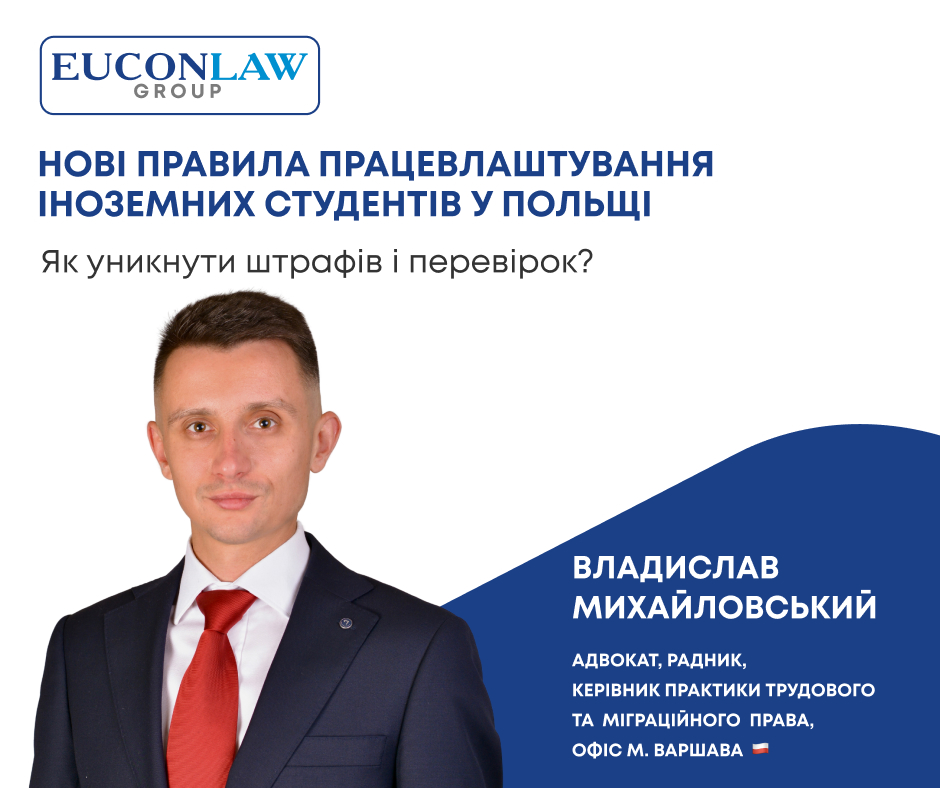
Vladyslav Mykhailovskyi, advisor, attorney at law, head of Labor and Immigration Law Practice
In urgent or particularly complex cases, direct contact with the Head of Practice is available: vladyslav.mykhailovskyi@euconlaw.com