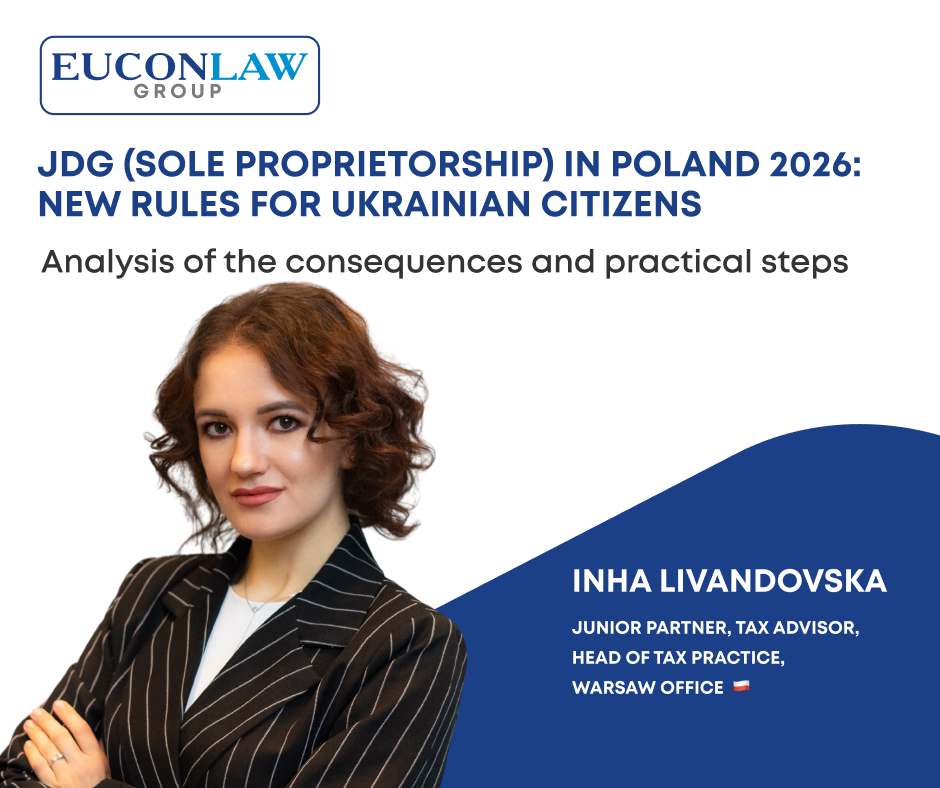
From March 5, 2026, simplified access to sole proprietorship in Poland for Ukrainian citizens will end. What has changed, who retains the right to JDG, and what needs to be done now.
With over 20 years of experience in the Polish and Ukrainian markets, the EUCONLAW Group team is observing another wave of legislative changes that directly affect thousands of Ukrainian entrepreneurs.
From March 5, 2026, new rules for the registration and conduct of sole proprietorship (JDG) by Ukrainian citizens will come into force in Poland.
The president has signed a law that repeals the decisions introduced on the basis of the Act on Assistance to Ukrainian Citizens in Connection with the Armed Conflict and restores the general rules for conducting business in Poland.
In practice, this means the end of simplified access to JDG for Ukrainian citizens. The possibility of continuing to conduct business legally in Poland now depends directly on taking the right actions.
Who retains the right to JDG after March 5, 2026
Only persons with a specific migration status retain the right to register and conduct sole proprietorship on terms similar to those applicable to Polish citizens:
- persons covered by temporary protection (holders of a PESEL UKR number),
- holders of a permanent residence permit,
- holders of an EU long-term residence permit,
- holders of an EU Blue Card.
⚠ IMPORTANT: Not every Ukrainian citizen will be able to register a JDG in Poland after March 5, 2026. The possibility of conducting business in this form directly depends on migration status. Each situation requires individual analysis.
Transition period: what does it mean in practice
The new provisions provide for a transitional mechanism for Ukrainian citizens who have started sole proprietorship on the basis of a special law.
A JDG registered before March 5, 2026, may be extended, provided that the person has legal residence status.
This means that even entrepreneurs who are already operating must check their status and take the necessary steps before the end of the transitional mechanism to avoid finding themselves outside the legal field.
JDG is more than just an entry in the Central Register and Information on Economic Activity in Poland (CEIDG).Registering as a sole trader is a strategic legal and tax decision. It affects:
- the amount of tax burden and the choice of taxation form;
- the extent of the entrepreneur’s personal liability;
- relations with contractors and financial institutions;
- obligations towards ZUS and tax authorities;
- the possibility of further legalization of stay in Poland;
- correct selection of PKD codes and registration as a VAT payer.
JDG or Company (sp. z o.o.) – what to choose?
In some cases, particularly in the case of higher incomes, cooperation with large contractors, or increased business risks, it may be more appropriate to register a limited liability company (sp. z o.o.).
- limited personal liability – protection of personal assets;
- increased trust from business partners and banks;
- more flexible tax planning;
- better protection for the business in the long term.
The choice of form of activity should be made after a comprehensive legal, tax, and migration analysis—there is no universal solution.
Practical steps: what to do now
- Check whether your migration status allows you to register or extend a JDG;
- assess whether sole proprietorship is the optimal form or whether sp. z o.o. should be considered;
- Prepare registration and tax decisions correctly, taking into account the new rules;
- Check that the PKD codes correspond to the actual activity;
- organize documents related to ZUS and obligations to tax authorities;
- consult on the optimal form of taxation for a specific situation.
Conclusions and recommendations
The 2026 changes significantly affect the possibility of registering and running a JDG by Ukrainian citizens in Poland. The new rules require a careful approach to both migration status issues and the choice of business form and tax decisions.
Given the complexity of legal and tax aspects, it is advisable to seek professional support at the planning stage. For over 20 years, EUCONLAW Group has been assisting Ukrainian citizens in legally conducting business in Poland, combining knowledge of commercial, tax, and migration law with practical experience in working with state authorities.
Registration is only the first step; conducting business activities requires high-quality and effective support.
Based on the experience of the group’s affiliated companies — E-REPORT, which provides accounting and tax reporting services, and Foreign Business Hub, which provides a legal address and administrative and secretarial services — after registration, entrepreneurs face the daily operational reality of accounting, tax returns, ZUS contributions, and handling official correspondence. Each of these issues is regulated by separate rules and requires a systematic approach.
E-REPORT and Foreign Business Hub are part of the EUCONLAW Group and are located in the same office in Warsaw, providing comprehensive and effective support for business activities, including JDG.
Author: Inha Livandovska, Junior Partner, Tax Advisor, Warsaw Office.