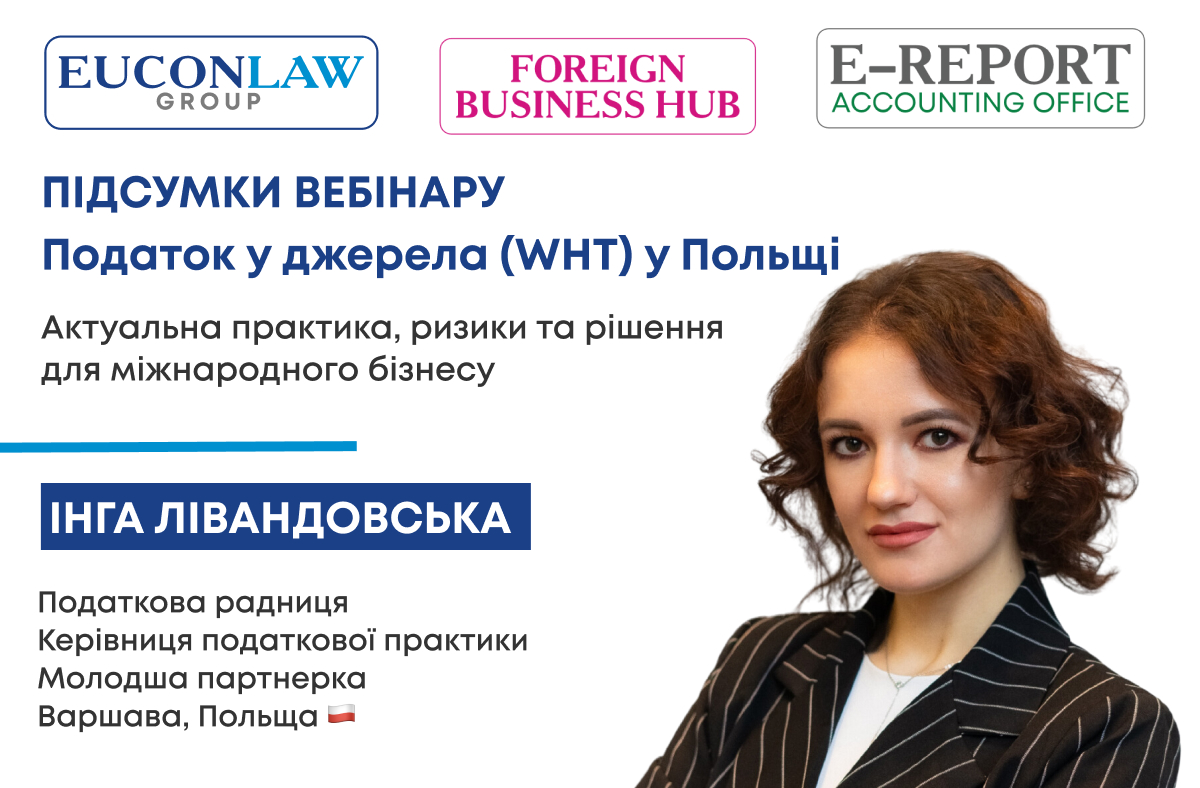
On 14 April 2026, Inha Livandovska, Tax Advisor and Junior Partner at EUCONLAW Group (Poland office), delivered a practical webinar for Ukrainian businesses operating in the Polish market on the topic “Withholding Tax (WHT) in Poland: Current Practice, Risks, and Solutions for International Business.”
During the session, the speaker shared up-to-date practical insights and real-life case studies faced by businesses in Poland.
In her presentation, Ms. Livandovska emphasized that withholding tax represents a systemic risk that is often underestimated by businesses. She noted that, despite its apparent simplicity, this area is characterized by a significant number of errors, reclassifications, and tax adjustments.
“Tax consequences are formed even before the payment is made — at the stage of structuring relationships, concluding contracts, and correctly classifying income,” the speaker stressed.
She also devoted particular attention to the application of treaty benefits, emphasizing that such benefits are not applied automatically and require the fulfilment of several conditions, including:
• obtaining a tax residency certificate of the counterparty;
• confirming the beneficial owner status of the income recipient;
• complying with due diligence procedures.
The speaker underlined that full responsibility lies with the Polish company as the withholding agent, which is obliged to withhold tax, verify documentation, and substantiate the application of exemptions.
She also highlighted the impact of the PLN 2 million threshold: once exceeded, the “Pay & Refund” mechanism is applied, which effectively changes the taxation model and creates an additional financial burden for businesses.
“Digital and intangible services remain the most problematic area. In particular, SaaS, IT services, and consulting are often subject to reclassification as royalties, resulting in the application of withholding tax. As practice shows, most issues arise not from intentional violations, but from the lack of proper analysis at the initial stage,” noted Inha Livandovska.
In conclusion, the speaker outlined key approaches to managing tax risks in the area of withholding tax:
• a systematic approach to counterparty verification;
• proper documentation of transactions;
• implementation of due diligence procedures;
• involvement of tax and legal experts at the planning stage.
Practice shows that timely analysis and proper structuring of relationships with non-residents help avoid significant financial losses and tax disputes.